
Published on

About Us
Lorem ipsum dolor sit amet, consectetur elit, sed do eiusmod tempor incididunt ut labore et magna aliqua.
Get a free quote
Mosquitoes Are Evolving to Evade Bed Nets – But There May Be A Solution

Indonesian Papua remains one of Asia’s most persistent malaria hotspots, but a new intervention is giving health experts hope
By; Sarah Newey, Global Health Security Correspondent, in Bangkok

Latest versions of spatial emanators look like a sheets of A4 paper in plastic covers which slowly emits an insecticide into the air. Credit: Uniteaid
In Papua’s low-lying mangrove swamps and dense tropical rainforests, mosquitoes have always got to work early.
Here, the disease-ridden insects begin feeding in the early evening as people socialise and children play. It’s a characteristic that’s hampered malaria control efforts, because it has rendered bed nets less effective. People are bitten before they climb under the netting to sleep.
It’s also part of the reason that Indonesian Papua remains one of Asia’s most persistent malaria hotspots. Last year, cases across the country jumped by 30 per cent, to 706,000 new infections. The vast majority, roughly 90 per cent, were reported in Papua’s six provinces.
The same pattern is now emerging in parts of sub-Saharan Africa, where mosquitoes used to bite mostly at night and where the rollout of insecticide-treated bed nets is estimated to have averted 450 million malaria cases between 2000 and 2015, according to modelling in Nature journal.
A number of studies suggest mosquitoes in Africa are evolving in response to the mass rollout of bed nets, biting earlier in the evening, or later in the morning. In some cases, species which already did this have become more dominant, while others are adapting their habits.
“We’re battling evolution. And right now, we’re losing,” said Prof Neil Lobo, a research professor in the Eck Institute for Global Health at the University of Notre Dame.
“Mosquitoes are adapting. They’re biting outdoors, they’re biting earlier in the evening when people aren’t under their nets, and they’re becoming resistant to the insecticides we use. So we’re reaching the limits of what bed nets alone can do,” he told The Telegraph.
But there may be a solution.
This slow-release insecticide could help fight mosquito evolution
How spatial emanators repel mosquitoes, inhibit their appetite, and sometimes kill them

Source: Neil Lobo, Eck Institute for Global Health
Last year, for the first time in four decades, the World Health Organization (WHO) endorsed a new mosquito vector control: so-called “spatial emanators”.
“This is the new intervention I’ve been most impressed by in the last few years,” said Dr Kimberly Fornace, an epidemiologist at the National University of Singapore’s Saw Swee Hock School of Public Health. “It seems like something that has a lot of potential.”
The concept is not that dissimilar from products like a citronella candle, mosquito coil or electric repellent, which work by releasing an anti-mosquito vapour, but with one crucial difference. The spatial emanators so far approved by the WHO are passive and don’t need to be lit or plugged in.
The newest version, made by US American company SC Johnson & Son, called the ‘Guardian’, remains effective for up to 12 months. It looks like a sheet of A4 paper in a plastic cover, and it slowly emits an insecticide called transfluthrin into the air.
It is not the same insecticide that bed nets are impregnated with and which kill mosquitoes. But trials and lab-based field studies in Indonesia, Thailand and Tanzania have found spatial emanators don’t just repel mosquitoes – exposure to transfluthrin can also suppress their appetite, stun and kill them.
“It’s not directly like the insecticide treated bed net, but a proportion [of insects] will die after exposure to the chemicals,” said Dr Iqbal Elyazar, an epidemiologist at the Oxford University Clinical Research Unit (OUCRU) in Indonesia. “The previous name was a mosquito repellant, but when the studies found the mosquitoes were also killed, the name was changed to spatial emanator.”
There is promising data. One study in PNAS in 2022 saw infections from viruses carried by the Aedes mosquitoes in Peru, like dengue and Zika, fell by 34 per cent over two years; and a major trial tracking 6,000 children in Kenya found first time malaria infections fell by 33 per cent, and overall new cases by 32 per cent. The results were published in The Lancet in 2025.

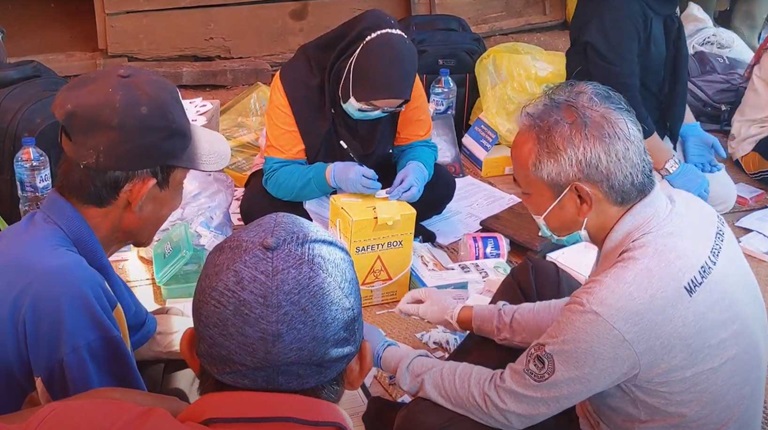
People with malaria visit a makeshift clinic for treatment in Papua Credit: Neil Lobo
But the WHO approval had a catch: the tool was only recommended for use indoors, alongside a bed net, because of limits in existing data.
The UN health agency said last August: “While this recommendation marks a major step forward, key evidence gaps remain – particularly around the effectiveness of spatial emanators when used alone, their potential to protect people outdoors or in humanitarian emergencies, and their role in managing insecticide resistance.”
Some experts have also warned not to let excitement outrun the evidence – as funding for malaria control comes under pressure, they fear spatial emanators will prematurely replace bed nets.
Now, Prof Lobo is part of a network of researchers across the world who are trying to answer those questions.
“Based on the data we have so far, spatial emanators look really promising. They’re not going to eliminate malaria on their own, and no single intervention will,” said Prof Lobo.
“To get to elimination, we have to break transmission between people and mosquitoes. That means treating infections in people, but it also means having really effective vector control.
Spatial emanators could help us close some of the gaps where our current tools aren’t enough.”
A big chunk of this work is being financed by Unitaid, which researches, funds and scales up innovative health products. Last month, the agency unveiled a further $36 million (£26m) for trials in Cameroon, Kenya and Myanmar.
As well as testing spatial emanators outside, in areas with low bed net coverage, and in cities, the money will also finance studies for promising tools, like insecticide treated baby wraps.
‘Papua a tough nut to crack’
But Prof Lobo has just spent a week launching another small trial, this time funded by the Asian Pacific Leaders Malaria Alliance, in Papua – where the disease still has a stubborn grip. Last time he worked there, in 2019, most of his team left with malaria.
“We’ve always had mosquito behaviours in Asia that did not favour our principle interventions against them,” said Prof Kevin Baird, a microbiologist specialising in malaria, and the programme director of the OUCRU in Southeast Asia. “[Bed nets] have not been terribly effective in many places in Indonesia, including Papua.”
But other problems have also hampered efforts to control the disease in the region, including patchy access to healthcare, limited human resources and infrastructure, and deforestation. Transmission here is also year-round, and the disease reservoir is “enormous”.

Larval sampling in a village in Boven Digoel, West Papua Credit: Neil Lobo
“In Papua, almost nothing has changed in malaria transmission [for 20 years],” Prof Baird told the Telegraph. “It’s not because the government isn’t trying, it’s just that the biology of the problem in the province is a particularly tough nut to crack… and the WHO’s technical strategy isn’t working here.
“We can’t just identify and treat cases in humans, we need real vector control to attack mosquito populations and diminish their numbers,” he said. “But since we stopped using DDT, we don’t have anything to really attack the mosquitoes – all we do is attack the ill. That strategy is no longer working.”
For Prof Lobo, the answer might just be spatial emanators.
The current trial, in collaboration with Hasanuddin University, the National Research and Innovation Agency Indonesia, and the OUCRU Indonesia, is relatively small – it will track malaria incidence over four months in two hotspots, Timika and Keerom.
But there are hopes that it could, along with much larger studies elsewhere, help answer outstanding questions about the technology’s strengths and weaknesses – and whether people will actually adopt them in a real world setting.
“Our existing interventions are really useful and have had a huge impact, but we’re starting to reach the limits of what they can do,” said Prof Lobo. “Malaria is still around and going up, and dengue and chikungunya are increasing in many places.
“So the question becomes pretty simple: what else can we do? We need to find new ways to protect people.”
Click to Read: https://www.telegraph.co.uk/global-health/science-and-disease/a-solution-to-mosquitoes-evolving-to-evade-bed-nets/
Tags:

Tags: